REFLECTIONS ON SOLZHENITSYN
Alexander Solzhenitsyn from beyond the grave

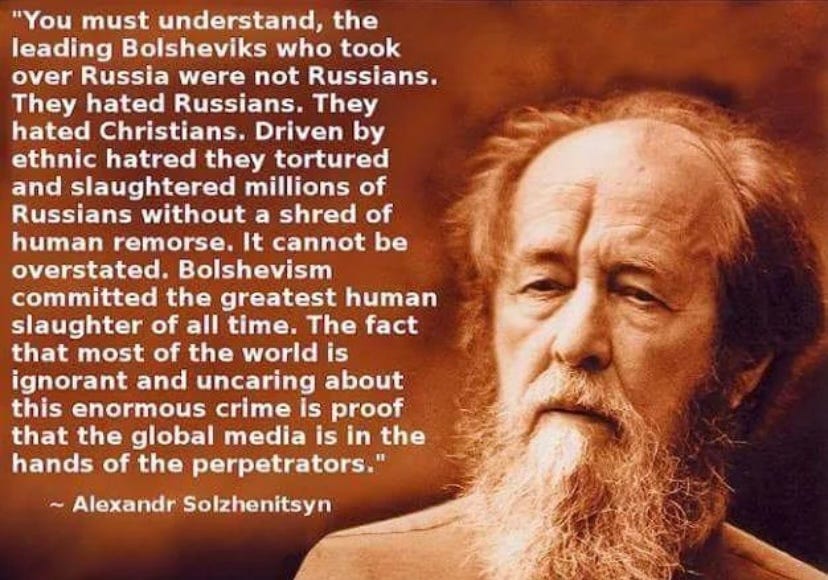
It is estimated that 60 million Russians and eastern Europeans were genocided as a consequence of Bolshevism and the Russian Revolution. Europeans fled in their millions but now the Bolsheviks have arrived. So now we turn to those who can guide us in this very dangerous time in his-story.
Key Dates and Life Overview
Alexander Isayevich Solzhenitsyn (1918–2008)
Born: December 11, 1918, in Kislovodsk, Russia
Died: August 3, 2008, near Moscow, Russia
Ancestry & upbringing: Born shortly after the Bolshevik Revolution. His father died before he was born; he was raised by his widowed mother, a devout woman who secretly kept her Christian faith under a regime that persecuted religion.
Early Life and War (1918–1945)
The Russian Empire had just fallen. The Bolsheviks had taken power (1917), leading to civil war (Reds vs Whites).
Solzhenitsyn grew up under Stalin’s totalitarian rule, when propaganda, censorship, and fear dominated life.
He studied mathematics and literature, joined the Red Army in World War II, and served bravely on the front lines.
In 1945, he was arrested for writing critical remarks about Stalin in a private letter which was the start of his imprisonment.
Imprisonment and Exile (1945–1953)
Spent eight years in Gulag labour camps, mostly in Kazakhstan and Siberia.
Survived extreme cold, starvation and forced labour.
Secretly began forming the stories and inner philosophy that would later become The Gulag Archipelago.
Released after Stalin’s death in 1953, but exiled internally in Kazakhstan for several years due to cancer and “enemy of the people” status.
Rise to Fame (1960s)
During Nikita Khrushchev’s “Thaw”, censorship loosened slightly.
In 1962, his short novel One Day in the Life of Ivan Denisovich was published in the Soviet journal Novy Mir — the first time the Soviet press allowed a truthful account of the Gulag.
He became world-famous almost overnight — a moral hero and conscience of Russia.
Persecution and Exile (1970s)
As the regime tightened again under Brezhnev, his works were banned.
The Gulag Archipelago, a massive, secret manuscript describing the entire system of Soviet camps, was smuggled to the West and published in 1973.
He was arrested and exiled from the USSR in 1974, stripped of citizenship, and sent to Switzerland, then to Vermont, USA, where he lived for nearly two decades.
Exile in the West (1974–1994)
In America, he lived quietly but warned against Western materialism and spiritual decay.
He argued that the West’s freedom was being undermined by comfort, consumerism and loss of moral courage similar to how Russia had lost its soul before the Revolution.
In 1978, he gave his famous Harvard Commencement Address, “A World Split Apart,” warning that the West, too, had forgotten God.
Return and Final Years (1994–2008)
Returned to Russia after the fall of the Soviet Union in 1994.
Spent his final years writing, reflecting, and observing the moral rebuilding of his homeland.
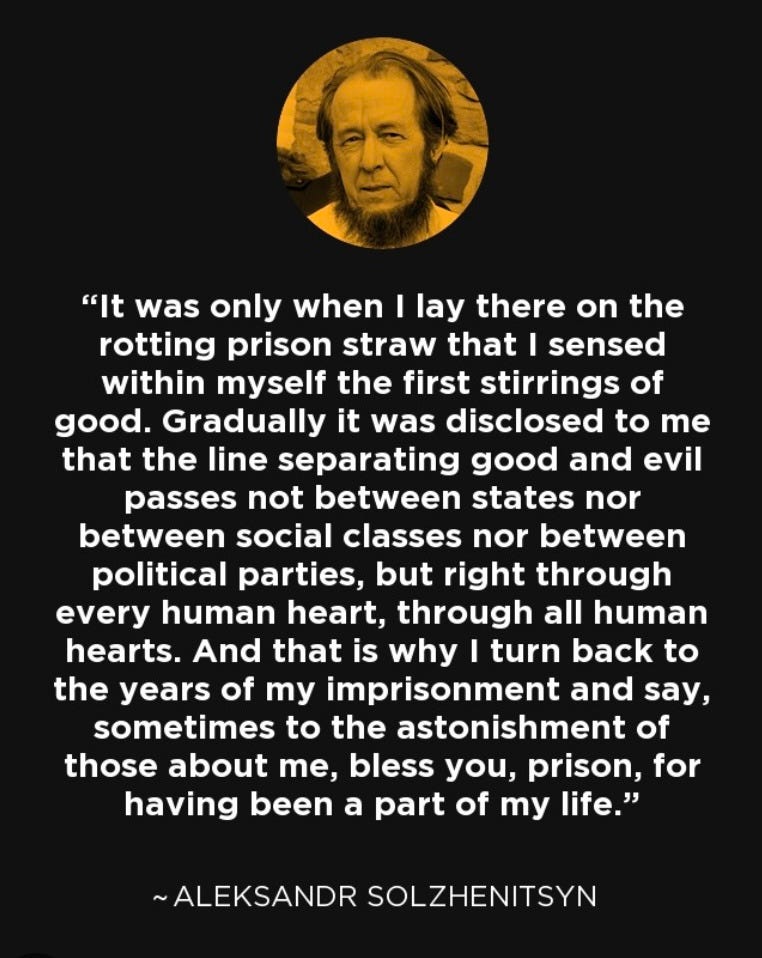
He was known as the Prophet of Conscience. They tried to silence him with ice and iron.
This poetic phrase refers to Solzhenitsyn’s imprisonment and exile in the Soviet Gulag, the vast network of forced-labour camps that stretched across the frozen reaches of Siberia.
“Iron” represents the prison bars, shackles, and iron discipline of totalitarian control, the machinery of oppression that tried to crush his voice.
“Ice” evokes the freezing wastelands where he was held; the Siberian cold, both literal and symbolic, in which the Soviet regime attempted to extinguish the inner fire of conscience.
Despite this brutal environment, Solzhenitsyn’s spirit was not silenced; instead, his faith and clarity deepened. He often described the Gulag as the place where his soul awakened — where he began to see suffering as purification and where he encountered the living reality of God.
Solzhenitsyn was not merely a writer, he was a witness; man who passed through the furnace of the Gulag, and instead of turning bitter, emerged luminous. His was the path of purification through suffering; the crucible that burns away the illusions of ideology and pride until only truth remains. He discovered that the line dividing good and evil does not run between nations or classes but through every human heart.
He saw what happens when man replaces God with the State, when the pursuit of heaven on earth becomes the construction of hell. In the Bolshevik Revolution, he saw not liberation but possession; a spiritual disease clothed in the language of justice.
He understood that communism was not merely a political error but a spiritual tragedy: the rebellion of man against his Creator for when men deny the soul, they justify every cruelty in the name of progress.
Yet Solzhenitsyn’s rebellion was not of politics but of spirit. He refused to hate. He wrote, not to destroy but to redeem memory…to give voice to the millions whose cries had been buried beneath snow and silence. Each word he wrote was a prayer carved into history, each page a confession, a psalm from the underworld of the twentieth century.
In exile, he became a prophet to the West warning that freedom without virtue is another form of bondage and that comfort without conscience leads again to tyranny.
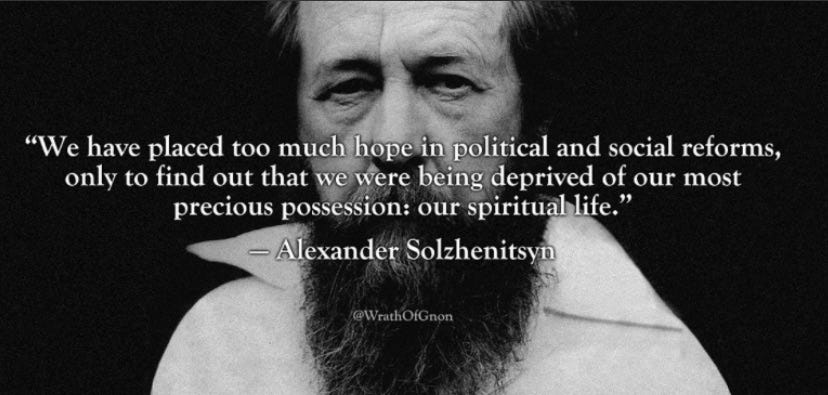
He saw that modern man, whether communist or capitalist, was in danger of the same disease: the worship of material progress over spiritual truth. He pleaded for repentance not of nations but of souls.
His faith was no gentle piety. It was a flame forged in Siberia; austere, ascetic, deeply Orthodox but alive with mystical conviction. He believed that suffering accepted in truth could cleanse a people; that through pain, one can return to God. He wrote with the gravity of a man who had seen eternity staring back through the bars of a prison camp.
And so, he became a living contradiction; a man of letters who spoke like a prophet, a soldier who fought with the pen, a survivor who chose forgiveness over vengeance.
Through him, Russia’s buried spirit rose again not as empire, but as conscience.
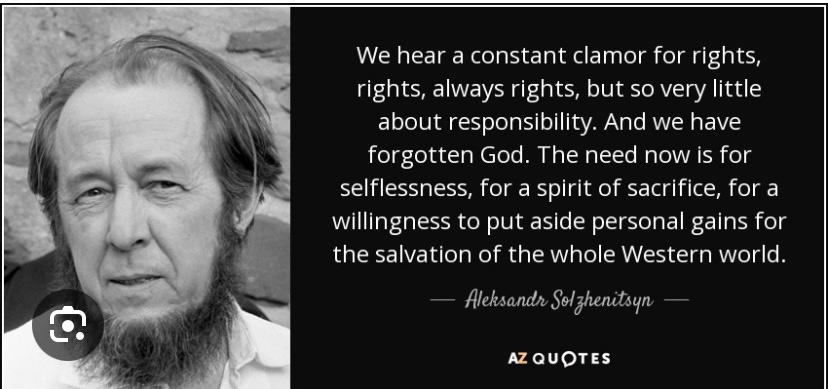
As we stand in our own time, another age of confusion where truth is traded for comfort and conscience is drowned by noise, the words of Solzhenitsyn return like a bell tolling through the fog.
He warned that the real battle was never merely political, nor even cultural … it was spiritual. A battle for the soul of man, for the integrity of truth itself. He saw that every empire of ideology begins not with a sword, but with a lie believed in the heart.
And every redemption begins with one awakened conscience that says, No more.
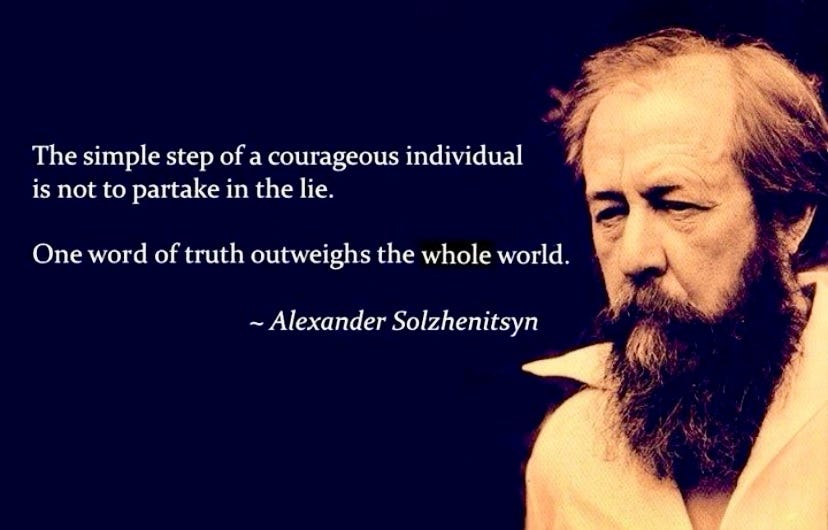
Much can be learned from him now for we too walk upon the threshold of systems that promise safety but steal the spirit. He taught that survival without faith is not life and progress without humility is ruin. He revealed that when a people forget the presence of God, they also forget the sanctity of one another.
And yet, whilst Solzhenitsyn spoke of God in the tongue of his Orthodox fathers, the language of icons and repentance, the faith of suffering Russia, I have journeyed far beyond that ancestral altar.
Through both the Orthodox and Jewish streams I have wandered, and through obedience to God’s Law I have come to rest among the ancient tribe of Judah, not by bloodline, but by spirit. I have been been embraced by spiritual kin despite the colour of my skin, for they recognise the mark of remembrance in my heart. It is there, among them, that I have found what can only be described as a newly remembered Natsarim path; the way of those who keep watch, who guard the covenant of love,
who remember that the Holy One still breathes through the branches of the Tree of Life.
And in this remembrance I have come to know the deeper meaning of Israel —
not the borders of a land, but the journey of a soul. Israel means “one who wrestles with God and prevails.” It is the name given to all who dare to struggle for truth, who refuse to surrender the light within them even when darkness closes in. It is not a nationality but a covenant; a living promise between Creator and creation. To be Israel is to rise after every exile, to remember the Voice in the wilderness and to walk the narrow path that leads home.
So when I read Solzhenitsyn now, I hear more than history, I hear prophecy. The battle he saw in the snows of Russia is the same battle I sense in the winds of our age:
between the mechanical and the miraculous,
between the empire of the lie and the kingdom of light,
between those who serve the beast of control
and those who remember the living Word written within.
And if we listen, his witness and my lineage meet upon sacred ground. For both declare that even in the darkest century, one heart aflame with truth can redeem a nation and one awakened tribe can birth a New Earth.
I feel Solzhenitsyn in my bones. As an ancestor. A spiritual forefather of conscience.
Solzhenitsyn lived as if truth were sacred. He risked everything rather than speak a single lie and many people who read him feel that same call to integrity and to faith in the divine.
His writings and life already act as a lamp; when you meditate on his words, it’s your own spirit that meets the presence of Yahuah through the truth he revealed. In that way his legacy is alive every time someone chooses truth over fear, the flame he carried continues to burn.